
How to decide between tools, platforms, or build your own
Your operator stack

Claude authors 80% of Anthropic’s merged production code. But they still hire aggressively for engineering and AI specialists with a massive consulting network. If AI is eating the world, why hire all these people?
Because work isn’t disappearing. It’s shifting.
More in planning, control, review, polish. Humans still do a remarkably good job of sorting out the nuance. That’s not going away.
How top operators use tools, platforms, and bespoke systems
For the Future of Focus we talked with 30 operators to understand their stack. The dividing line was clear: human judgment. Generic, low-judgment tasks are where today’s AI tools shine. The second question is how bespoke the solution needs to be. Off the shelf tools work quite well for generic tasks but start to crack as you need more customization. That’s where platforms and build your own start to become real alternatives.
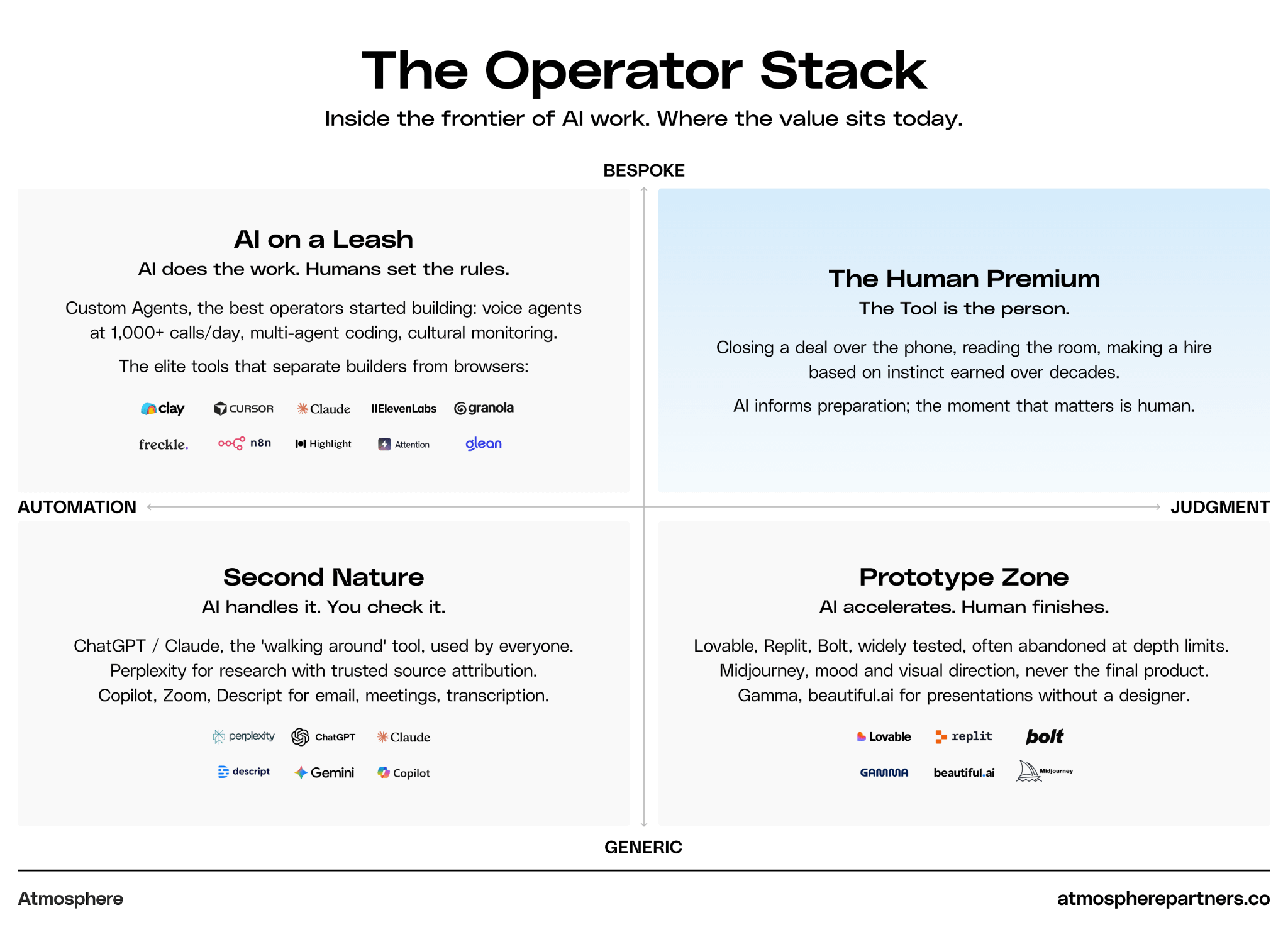
A simple way to place your workflows.
In our previous post, we outlined how to pick apart workflows within your company and create an ROI calculation for each.
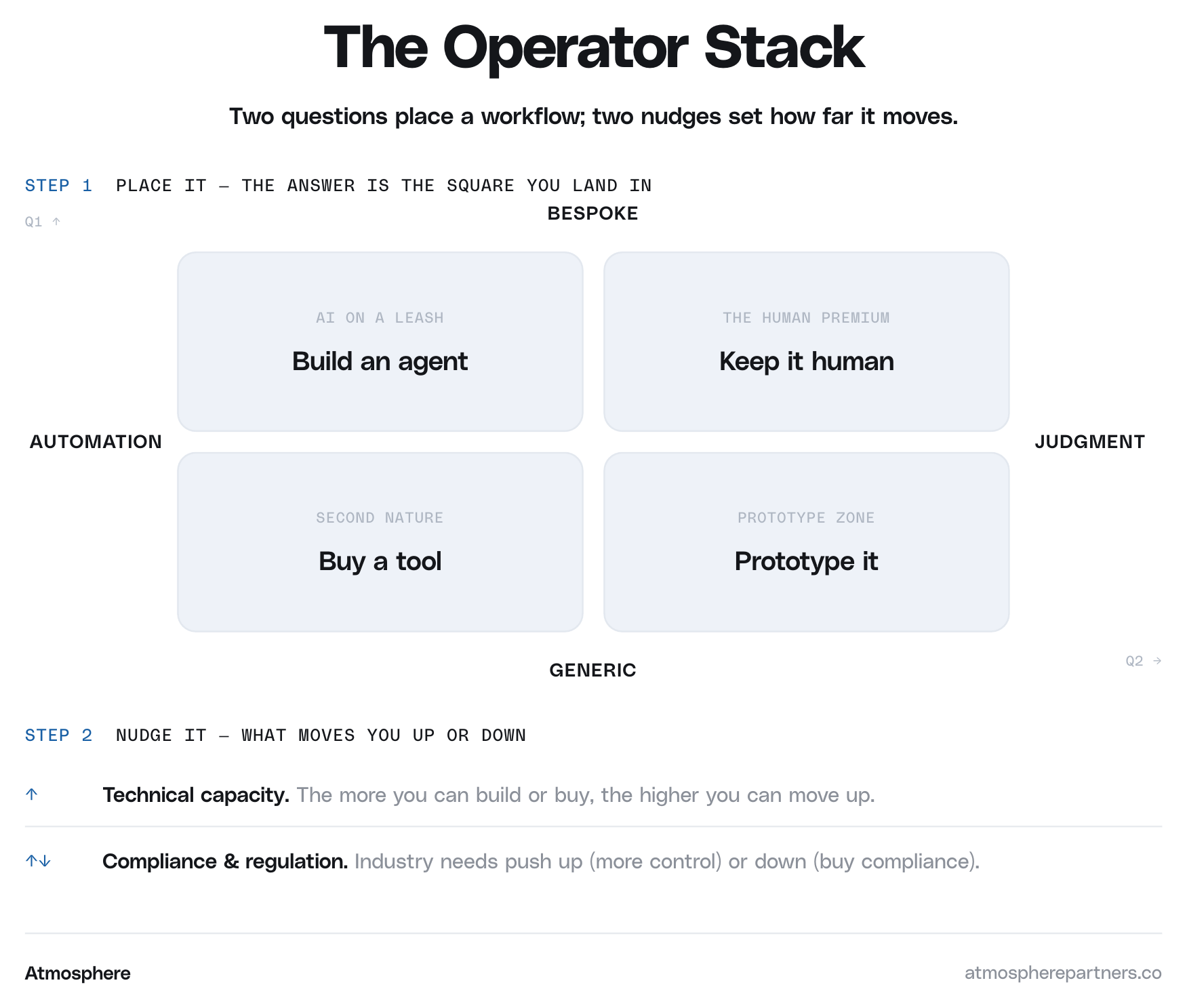
Now we want a simple framework to understand how to choose tools, platforms or build your own. You want to plot your workflows onto the matrix. You can use the precise values from the ROI calculation to accurately place these into the matrix.
How much judgment does the workflow take? The more nuance and human judgment required, the more you move to the right. You may use prototyping for the idea but the end product is distinctly human.
How customized is the workflow? Generic workflows like searching for email addresses or building customer lists sit at the bottom in tool or platform territory.
After this you need to nudge up and down based on your technical capacity or budget, and compliance and regulatory. Most companies work through a migration path of tools first, platforms with more experience, then custom solutions as ROI and capability increase. You can quantify this but it becomes more of a judgment call than a simple heuristic.
One golden rule: never use AI to automate your core competency. If you’re paid to be the best at it, use AI for the context around the work, not the work itself.
For example, enterprise sales companies can automate the market research, contact sourcing, meeting notes, and action item creation, but you never want to have high-volume cold outreach for a deal that requires warm intros, serious multi-threading or relationship-based selling.
The Atmosphere example
At Atmosphere our major workflows span strategy articulation, relationship management, content creation, deliverable creation, scheduling, and product development. We had the benefit of starting the company from scratch so had to make every SaaS and AI buying decision against a real budget and expected P/L.
We first mapped our workflows into the matrix. That gave us a sense for which pieces of work we wanted to apply AI to. In the discovery, we knew we ultimately needed a consolidated system that gave us context-lift for the keep it human piece. But deliverable creation is a ton of market research, competitive analysis, content structuring, and client context. The work is intensive and requires high AI leverage.
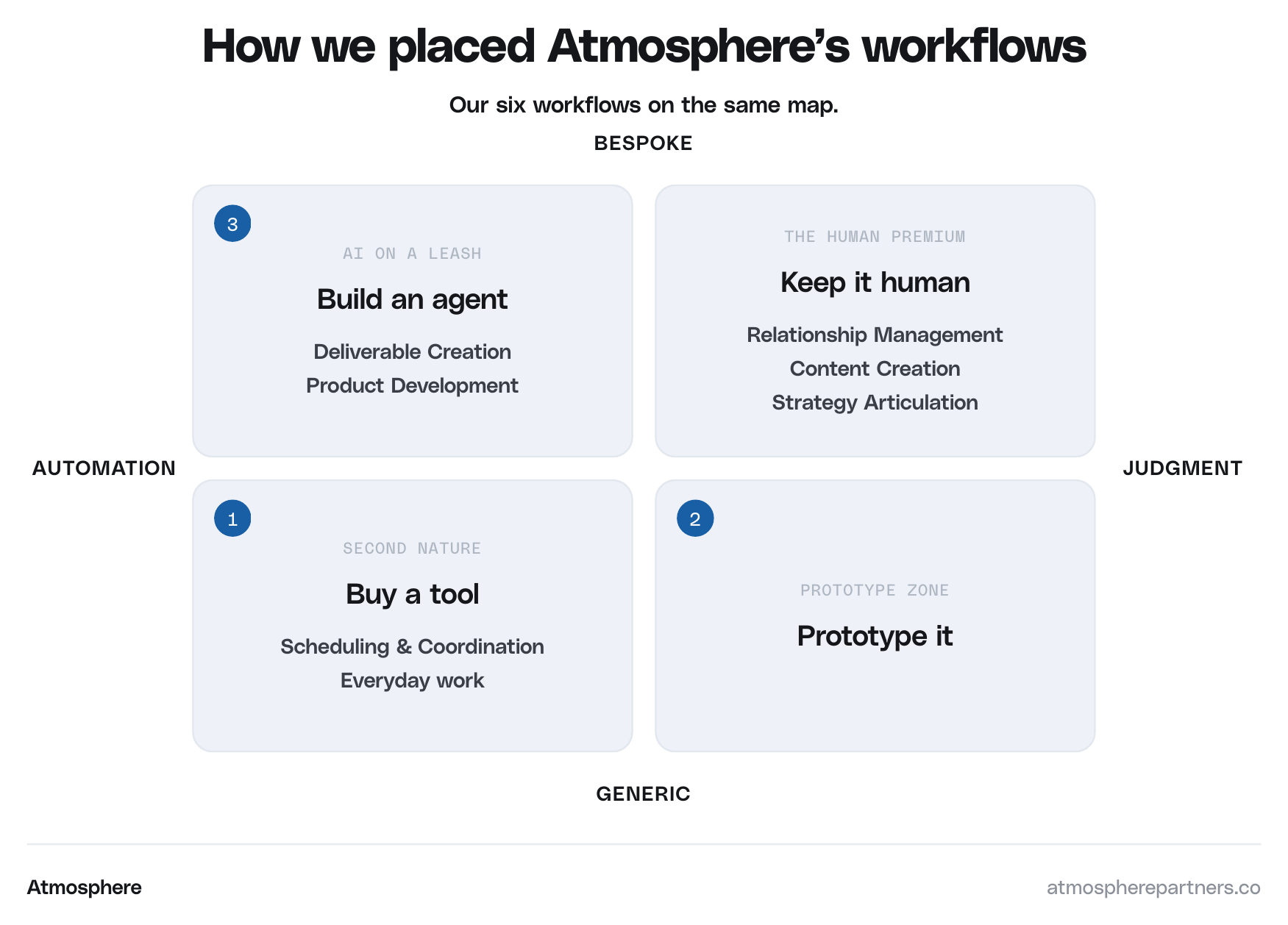
Because we have technical aptitude from 20+ years in consumer tech, we decided to build. We created a system of agents with an orchestration layer called Convector. The invisible engine in the atmosphere that powers flight.
Our pathway was a migration. The blue bubbles on the map above.
We started with buying tools (Claude, ChatGPT) to see if that could solve it. Too verbose and generic. The work required high judgment and was bespoke. The output wasn’t good enough and worse took us more time in correction than just writing it ourselves.
We moved into the prototype zone. We built an initial version on Replit to see if we could do better than Claude or ChatGPT on its own. Turns out we could. By tying our proprietary framework and business process IP to the data produced from AI we could deliver a step-change better deliverable than Claude on its own. It also clearly beat doing the work purely by hand.
We built a system of agents. We productized Convector and migrated everything over to real infrastructure. We built an eval and self-reinforcement loop so the system would get smarter and give us compounding leverage. More on this in a few weeks.
In the end it was about understanding our workflows, planning where to apply AI, and building only what we needed to.
Next post: our picks for platforms and tools.