
The Future Belongs to Opinionated Brands
The old discipline for standing out in the new age of AI


Last week we made the case that the AI category is starting to look like a commodity. In short, every company sounds the same and looks the same. So if you’re trying to position something inside this market in a way that actually stands out, where do you actually start?
This is the methodology piece. There is a real process for getting to a unique position worth defending, and most companies have skipped it. Here are four ideas that have shaped how we think about positioning in the age of AI.
It’s not what you make, it’s where you stand.
In simplest terms, positioning is what the product does and who it is for. Taken one step further, it is the organizing idea for everything your company does, the product, the user experience, the sales motion, communications, even hiring. Get it right and decisions start to flow like water.
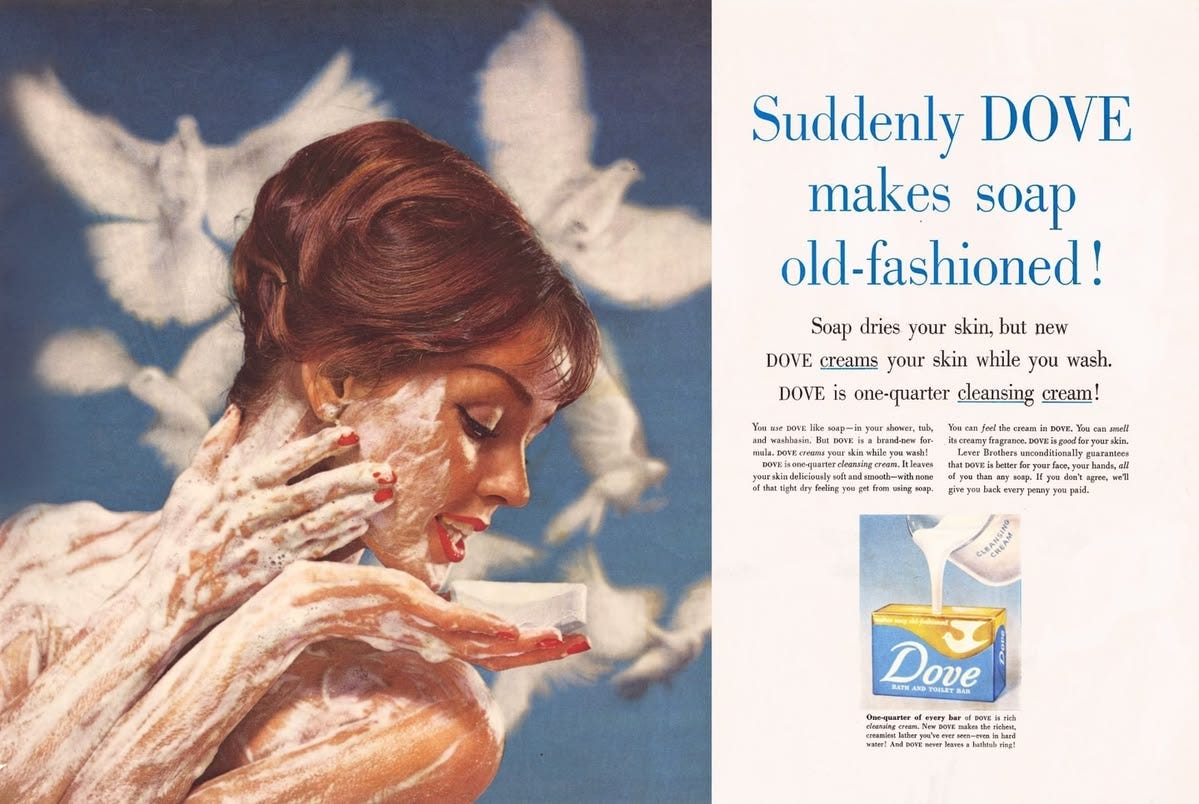
One iconic example of positioning was from ad legend David Ogilvy. Rather than positioning Dove as a detergent bar for men with dirty hands (like everyone else), Ogilvy positioned the soap as a beauty bar for women. He believed that “the most important decision is how to position your product.” His campaign for Dove soap became one of the most successful and enduring ads of all time.
That was in the 50’s, so what’s changed since? Getting from a brief to a locked position used to take a creative agency the best part of 6 months, endless rounds of research, reviews, and revisions. It also cost a lot.
Today, you can prompt your way to a new tagline, positioning statement, or even a logo over your morning coffee. The bad news is that by missing the messy middle, you bypass the part that actually differentiates the business. The result is a sea of sameness, visually and verbally.
BLANDING 2.0
We’ve seen this before. Today’s brand AI homogenization is what the industry called ‘blanding’ in 2018, the millennial pastels and friendly tone of voice you couldn’t escape from. The excellent essay ‘The Age of Average’ called this out, specifically the way brands seem content to converge on a single safe mean. Back then, every brand was built on ‘purpose’ and wanted to make an ‘impact’. The sale of transparency pioneer Everlane to climate destroyer Shein last month felt like a closing note on the era of brands built on this movement.

So here are four ways to stand out today.
START WITH CONSTRAINTS
In a world of abundant options, the most useful thing you can do is take some away.
In David Epstein’s latest book ‘Inside the Box’, he argues that boundaries are what produce breakthroughs. From Dr. Seuss restricting himself to only using 50 words to Victor Hugo hiding all his clothes so he would focus on writing vs going out. The constraint was the engine.
For companies, the brief has been a strong guide for this. During my time at Saatchi & Saatchi, I was taught to strip away and subtract as much as possible, to distill the ask. The tighter the brief, the better the work. It was always uncomfortable to reduce it down, but it always paid off.
Most AI-led work fails here, because the sources are endless, so the brief becomes wide, and the output is generic.
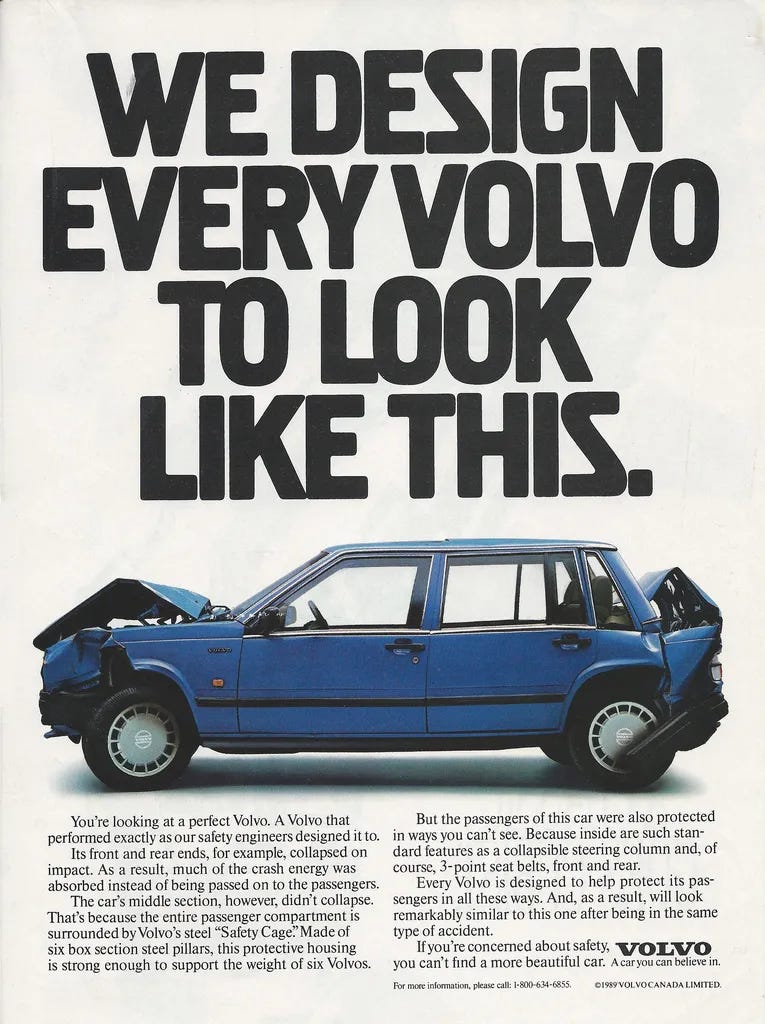
Volvo is proof of this at scale. In a car market obsessed with speed and style, it chose the unfashionable corner, safety, and owned it so completely that the word still belongs to them decades later. Whilst everyone else was competing for the same words, Volvo took one nobody wanted and made it theirs. The constraint was the strategy.
GO IRL
If your impulse is to prompt your way to a positioning, then your response will be average. To change things up, you have to go after unique sources. Two are our religion:
Primary Research
Interviews, event interactions, even customer complaints, which are unscrapeable by chatbots and uniquely yours. In the early days of Airbnb, founder Brian Chesky went door to door asking hosts what the product actually felt like to use. Paul Graham called this ‘doing things that don’t scale’. The result? You get a much deeper understanding that you’d never achieve purely online.
Ethnography.
This is the art of observing customers in their own world rather than asking them direct questions. Intuit’s founder Scott Cook built a multi-billion-dollar company on this practice, one he called ‘Follow Me Home’, waiting in the store until someone bought the product, then sitting in their kitchen to watch them actually use it. The idea is that what people do and what they tell you they do are rarely the same thing.
Change the Perspective, Change the Answer
Most positioning is done from inside your office. Where actually a sharper position can come from looking through someone else’s eyes.
There is one classic framework we use that positions every brand through four lenses: company, category, consumer, and culture (the 4 C’s). The obvious answers often live in the first three: what we make, who we compete with, who buys us. Culture is the one that pays off, because it tells you what’s happening around the business, not inside it.
Another approach is older and simpler. In 1985, with Intel’s business collapsing, Andy Grove asked co-founder Gordon Moore a question: “If the board fired us and brought in a new CEO, what would he do?” Moore said, “get us out of memories”...So they walked out the door, came back in as outsiders, and abandoned the position that built them (memory chips) and claimed a new one (microprocessors). Same company, just seen with a fresh pair of eyes.
This is also why we tell clients to remove “ER” words. Better, faster, smarter, cheaper. Every one is a comparison that tethers your position to your competitors. The head of Rolex understands this and when recently asked how the watch business was going, replied “I don’t know, I’m in the luxury business”. He refuses to be in the category everyone else is fighting in. That is the move that makes you stand out.
Truth & Tension
Once you have some positioning options, the last step is to figure out which one is actually worth holding onto.
The first test is truth.
Start by asking: what is the customer actually buying? Nobody buys AI in isolation. People usually buy for one of the following reasons:
a problem solved (Uber)
a task made easier (Calendly)
a founder’s unique perspective of the world (Elon)
a promise of a new version of themselves (GLP1’s)
Hold each potential position against these, and you’ll reveal the strongest options.
The second test is tension.
Most brands try so hard to be inoffensive (see 2020’s playbook for ref) and therefore blend in and remain invisible.
Your positioning has to be willing to be disliked by people it is not for.
Liquid Death is a great example here. ‘Murder your thirst’ + provocative heavy-metal branding in a category of soft, clean-living is impossible to ignore. And now they own a sizeable slice of the entire category.
Water Bottle Interest Over Time - How Bold Positioning Pays Off
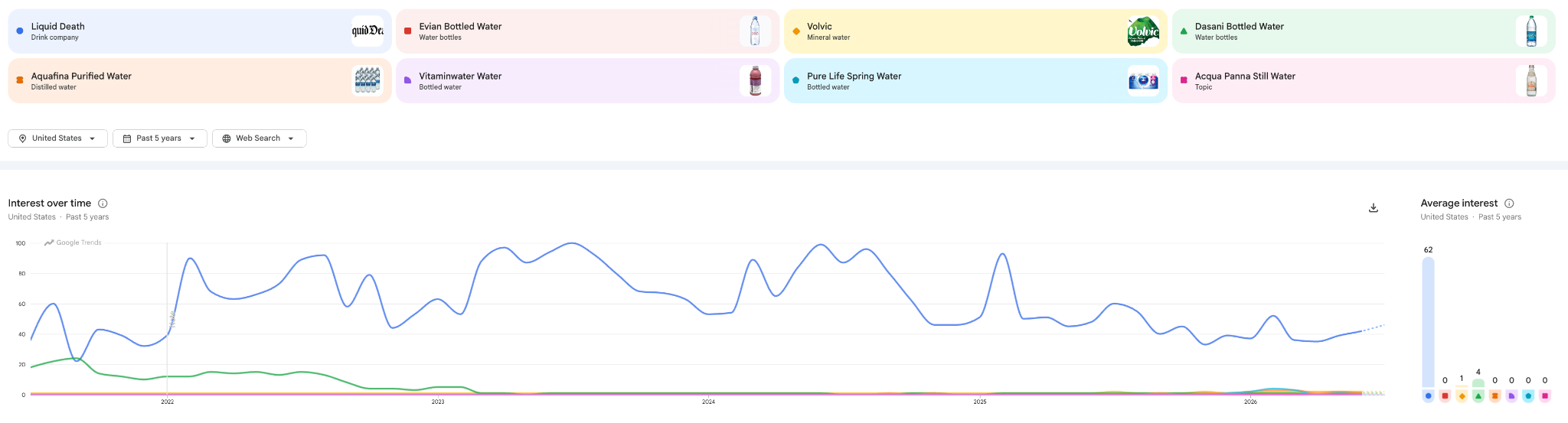
Try to optimise for distinctiveness. When you create tension, it’s a sign you are onto something.
Now what next?
One caution before you fall in love with your new positioning. The sharpest position does nothing until the product, experience, and operation can actually deliver on the promise it makes.
The tools we have today have made it free to sound like everyone else, which makes it more valuable to stand somewhere specific.
Next…a deeper dive to find out whether every brand in the AI era is starting to look and sound the same, and what to do about it.
 | A guest post by
|
 | A guest post by
|