
Why "AI-Powered" Stopped Meaning Anything
Removing the Residue of the Machine


The only thing growing faster than AI right now is how much people hate it.
From farm towns fighting back against data centers to students booing commencement speakers, it’s clear something has shifted.
During his Odyssey press tour, Christopher Nolan put it plainly, “I’ve never seen a technology that’s been so successfully adopted by Wall Street and by investors and by tech companies that the public has so thoroughly rejected.”
This is a story about how fast the public perception has turned, and how slowly most companies have responded.
The brands paying attention are already ahead.
Anthropic won this year’s Super Bowl cultural conversation by showing chatbots interrupting personal conversations, mirroring their earnest tone and overeagerness. Claude moved from 41st to 7th on the App Store within days.. They have quickly become the anti-AI AI company. By taking a position against the drift of their own category, they are winning.
They are not alone. Nikon’s Natural Intelligence campaign mimics the format of AI image prompts and then reveals each photograph was taken by a real person in the real world. Its tagline reads: don’t give up on the real world. While writing this, Substack introduced a feature to show how much content was written by AI (this post was verified as 100% human), these are good signals.

A new class of start-ups exists to strip AI out of the experience. Sinceerly removes the telltale signs, the em dashes, and even suggests typos. Extra’s founder put it simply on LinkedIn during their launch: “The fastest way to make a consumer AI product feel boring in 2026 is to keep reminding everyone it’s AI.”
The companies closest to consumer trust are racing to remove the residue of the machine, and it’s bearing fruit.
Meanwhile, walk through any business conference and the inverse is happening. Every one has a variant of “AI-powered.” Every deck has the same messaging. Even the logos are drifting into the same floating orb shape.
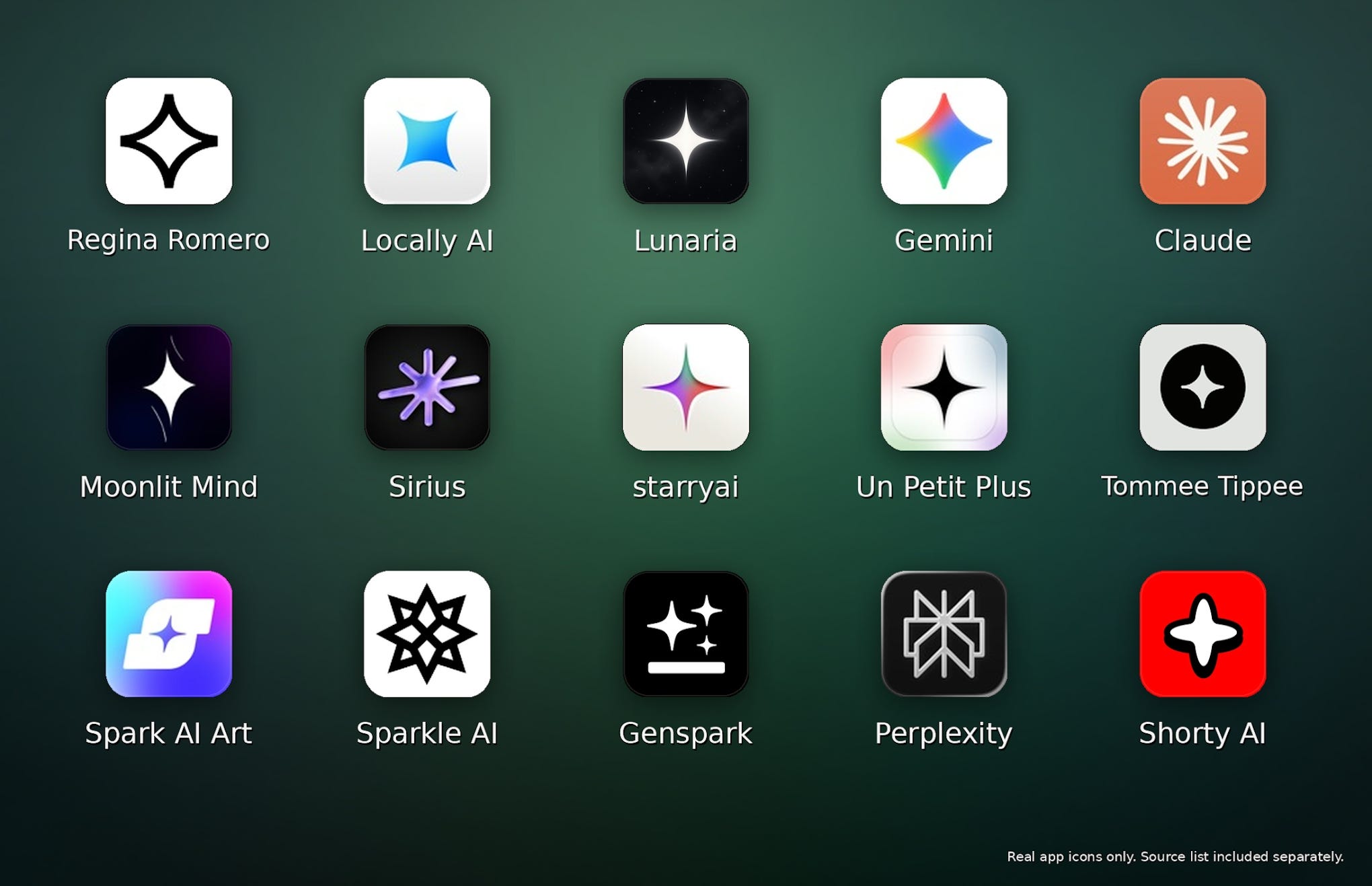
It is worth being clear about what’s actually happening here. On one side, the media is writing about AI on every page, because AI is the story right now. However, that doesn’t mean a company has to put AI on every page of its website. Those are two different jobs. One is reporting, the other is positioning. The companies confusing the two are paying for it in trust.
The market is correcting in public.
331 S&P 500 companies cited “AI” on their Q4 ‘25 earnings calls. Through the first ten weeks of ‘26, those companies returned an average of 1.5%. The companies that did not mention AI returned 5.6%. For three years, the word operated as a premium phrase on earnings calls, but now that has flipped.
The public is further ahead. In March 2026, NBC published a report where AI achieved a rating lower than ICE! Among voters aged 18-34, the rating was minus more than double the national figure. These are people who grew up with the technology and that brands most want to reach.
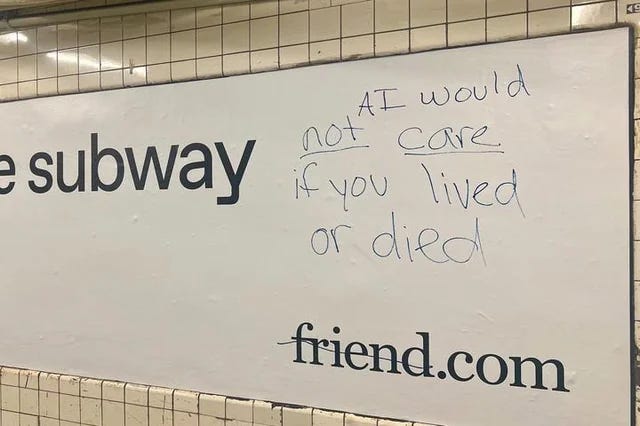
Then there is the cultural reception. Friend.com’s subway campaign in New York was defaced within days of going up; commuters scrawled “surveillance capitalism” and “AI wouldn’t care if you lived or died” across the posters. The New York Times ran a piece on the backlash. This was a reality check for founders deep in the San Francisco bubble.
It is worth saying that the AI industry has not helped itself. The dominant narrative has been about job losses and the end of humanity, reinforced by billionaires being interviewed in flattering (and extremely long) podcasts by interviewers with no stomach to push back. The technology has been positioned, notably by its own architects, as an existential threat, and, surprise, surprise, people are not up for it. Now, under a Zuckerberg-esque PR makeover, they are walking it back.
Two markets, the equities market and the consumer market, both correcting on the same word at the same time.
Brand is dead. Brand is everything. Both are right.
Two of the sharpest commentators in business have read this moment in opposite directions. Scott Galloway has argued that brand is dead, that the cost of building an audience has collapsed and that traditional brand advantage is dissolving. Paul Graham argued the opposite: that we are entering ‘The Brand Age’, when technology converges and every product is functionally identical, brand becomes the only remaining differentiator.
Both are right. Brand has been compressed. Today, it’s less about awareness and more about the specificity of your position. When every AI product can do roughly the same, the position “AI-powered” stops carrying weight. The cost of saying it is now greater than the cost of staying silent.
Ultimately, it’s not about whether to use AI, everyone uses AI. The question is whether the audience can clock it in the work you put out into the world.
Can you “clock it?”
A few weeks ago, I sat in the audience at an event and listened to a speech that had clearly been written by AI. He started with a negative to positive (it’s not x, it’s y), then outlined 3 examples (I was x, y, and z). By the end, most people were on their phones. It lacked any personal touch or roughness; it was too obvious and polished. Ultimately, people just don’t talk like that in real life.
Look through the hellscape that is LinkedIn, or even your emails and you’ll see it everywhere. What was once a fun experiment has started to become disrespectful.
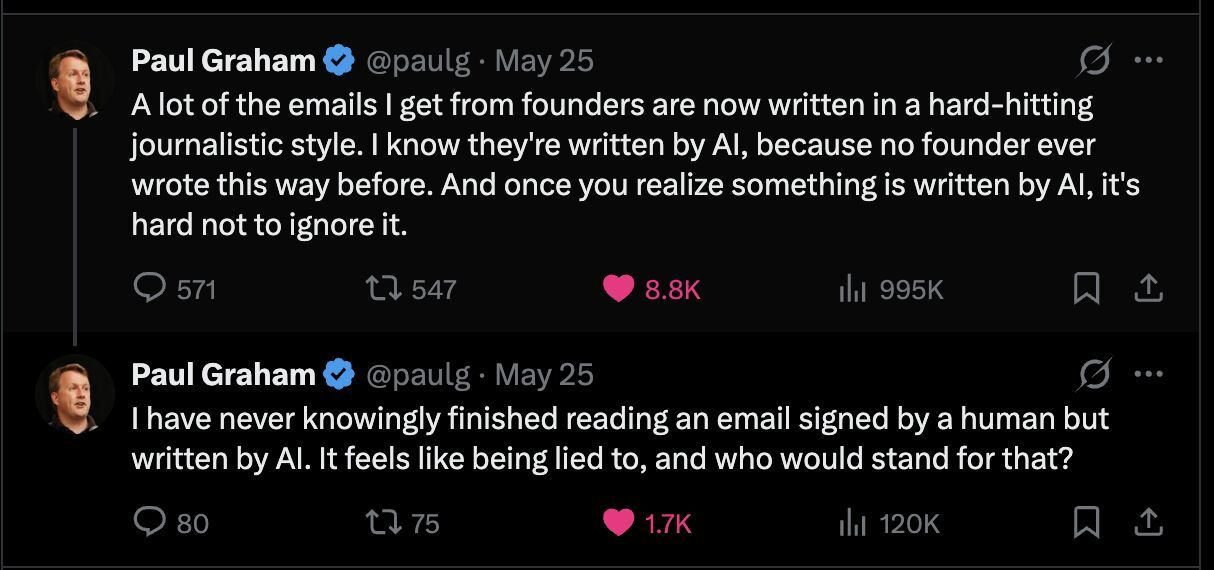
Great work subverts your expectations. That is why people clock AI, because there is no friction in it. LLMs are particularly bad at making content that surprises you, because they are designed to produce the average of what has been said or done before.
This is now measurable. Cornell researchers sampled 20,000 stories from four leading models and found that the same eleven words appeared in 88% of them. The most common protagonist, a man usually called Elias, now fronts AI-generated books and health guides sold on Amazon.
We are all developing this pattern recognition faster than the tools have learned to evade it.
In our work at Atmosphere, Scott and I have stripped this kind of language out of client websites, ads, landing pages and decks, and watched the numbers move. At the very least, the exercise forces us to ask the crucial question of what is actually unique about this business. “AI-powered” isn’t an answer.
The presence of a machine implies the absence of care, and the absence of care is what the customer now penalises.
The discipline behind the work
There is a craft behind getting positioning right in this market, and it is increasingly important. In The Future of Focus we called this moment The Imprint: the taste, judgement, and conviction that remains in the work after the tools have done their part. The Imprint is what cannot be generated.
The discipline behind it is both intellectual and emotional. It involves inputs that the tools cannot scrape from the web, gleaned from in-depth interviews and ethnography, and it involves the willingness to hold a tried and tested framework and a gut feeling at the same time.
In the AI era, advantage will accrue to the companies bold enough to refuse the easy path and the obvious output. Everything else is the residue.
This is the first in a two-part series.
Next week: the science behind getting positioning right, the inputs and processes that unlock uniqueness and the tests that separate a real insight from a confident sentence.
 | A guest post by
|
 | A guest post by
|