
What to actually do with AI at your company
Your practical AI implementation map

You have an AI mandate. Don’t jump straight to tools. Start by mapping your organizational problems. Simple but often overlooked.
The cost of failure is high. Think in terms of the 1-10-100 rule; $1 in prevention is $10 in correction and $100 in failure. Adapted for the AI era this gets worse:
$1 in design is $10 in engineering, $100 in tokens, and $1,000 in failure.
Catching flaws in design is cheap and easy to fix. Letting them slide into production can be catastrophic.
The Imprint
In The Future of Focus we talked about the Imprint: the point where human judgment and taste reign supreme. It’s the most critical concept for your AI implementation plan.
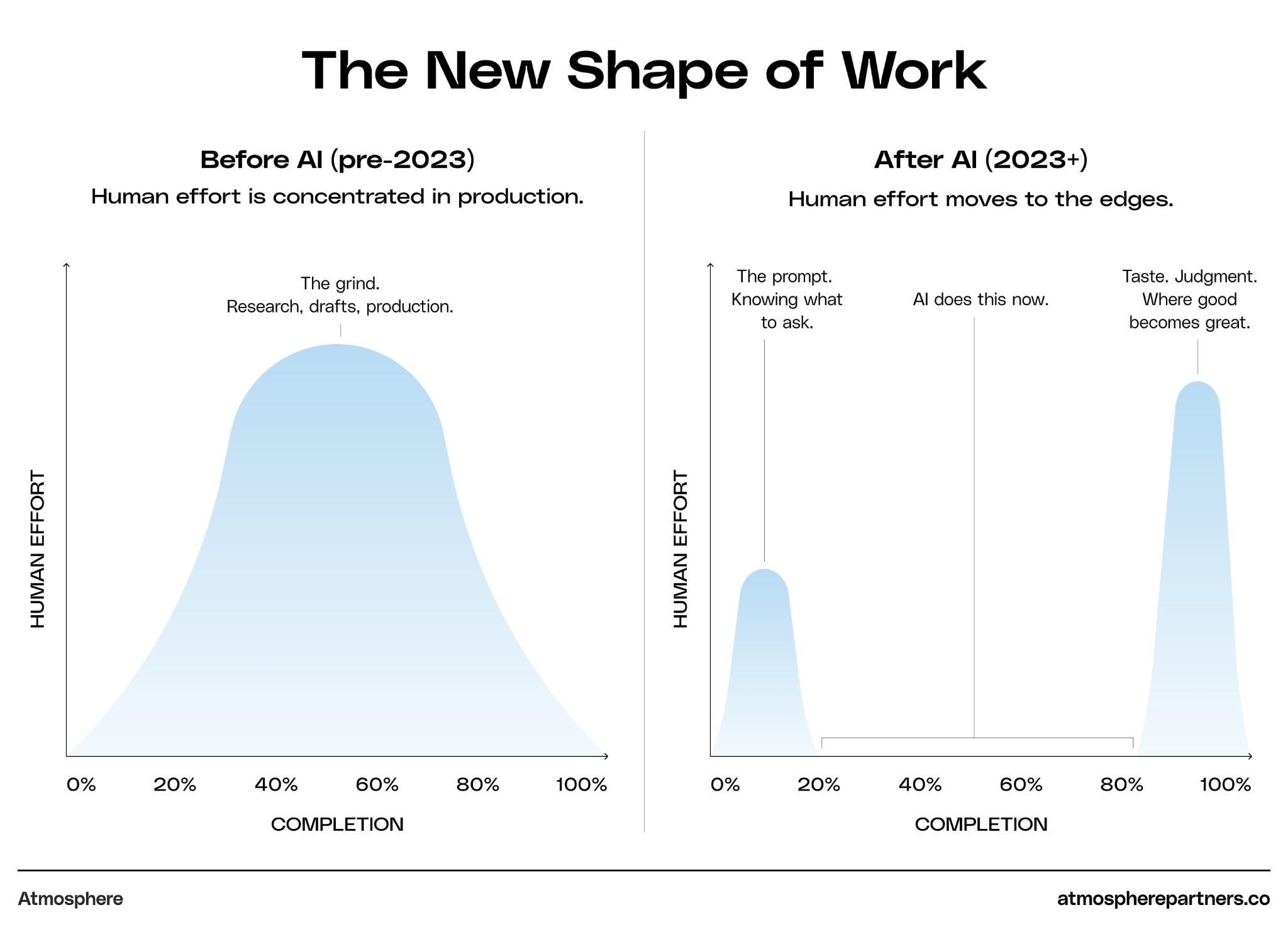
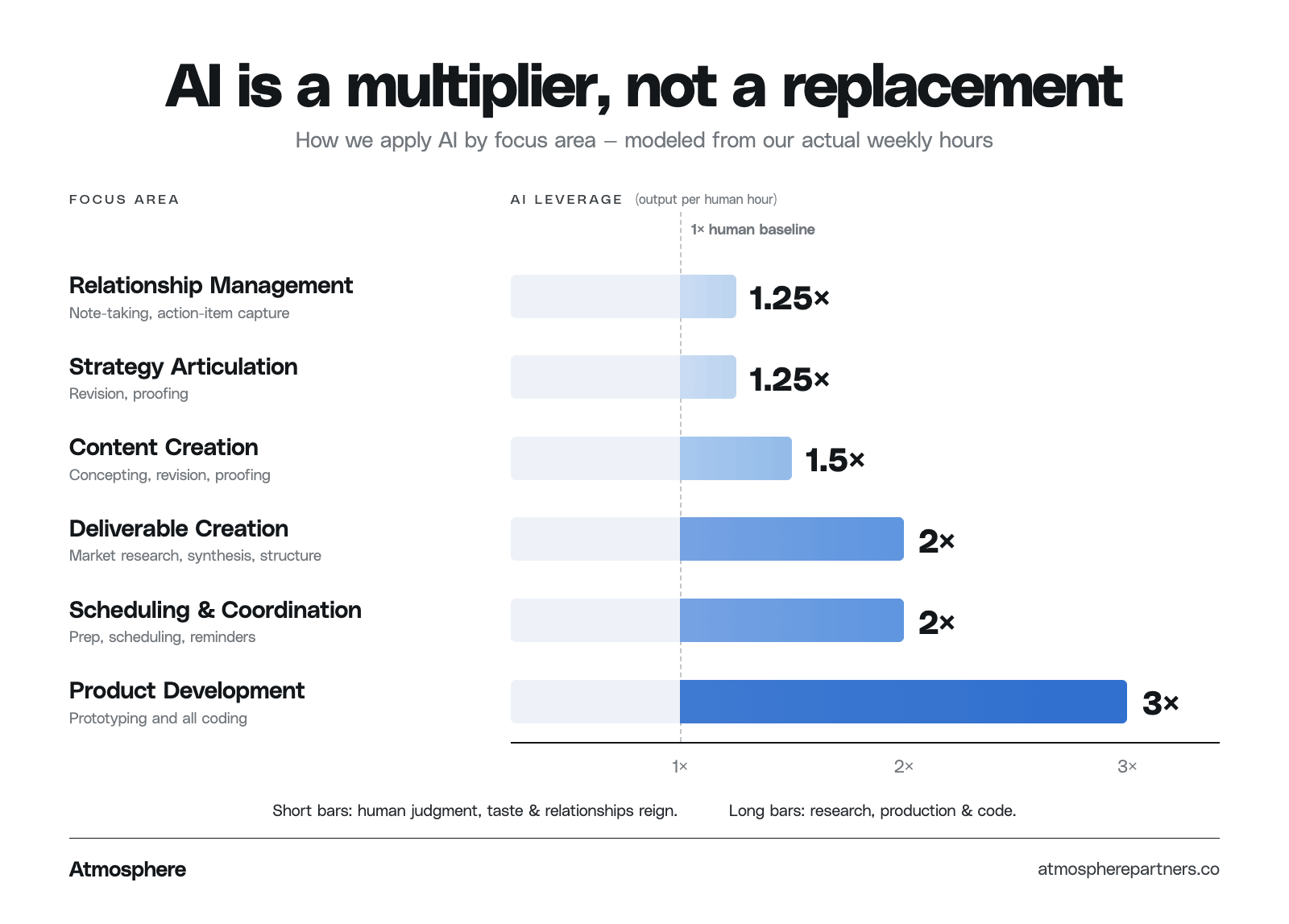
At Atmosphere we view AI as work augmentation. We’ve done the modeling on our actual hours spent and put sharp lines around where we expect high leverage from AI and where output is almost entirely human.
As a small firm, we need 2x blended AI leverage.
Our content, for example, is entirely human written. We use Claude for revision and proof edits, and Claude Design for visuals based off a hand curated brand kit.
We don’t use AI for any initial drafts or even concept suggestions. The quality is too low and doesn’t communicate in a voice we feel is authentic. That caps the AI leverage and we’re comfortable with the trade-off.
Three Core AI Use Cases
The AI implementations we’ve worked on all boil down to the following:
Personal productivity: research, writing, editing, coding, email etc.
Workplace productivity: augmenting specific workflows*
Product development: embedding AI into customer-facing products
* Many companies seek full workflow replacement. In our experience this almost never works.
Discovery
Map and quantify your workflows across the organization. Note that if you’re using AI to speed up a particular function (Sales), you need to ensure the rest of the organization stays in sync (SalesOps, Finance). If you don’t…
We call this the feral otter. The AI enhanced workflow starts to gobble up the rest of your company. Problems get worse and messier before any improvement.
The discovery work is painstaking but straightforward. Here’s a simple plan:
Internal interviews with users on workflows (3-5 per area) depending on size
Interview synthesis and workflow quantification
Trade-off analysis of AI implementation vs. standard operating procedure
Tool selection and platform choice
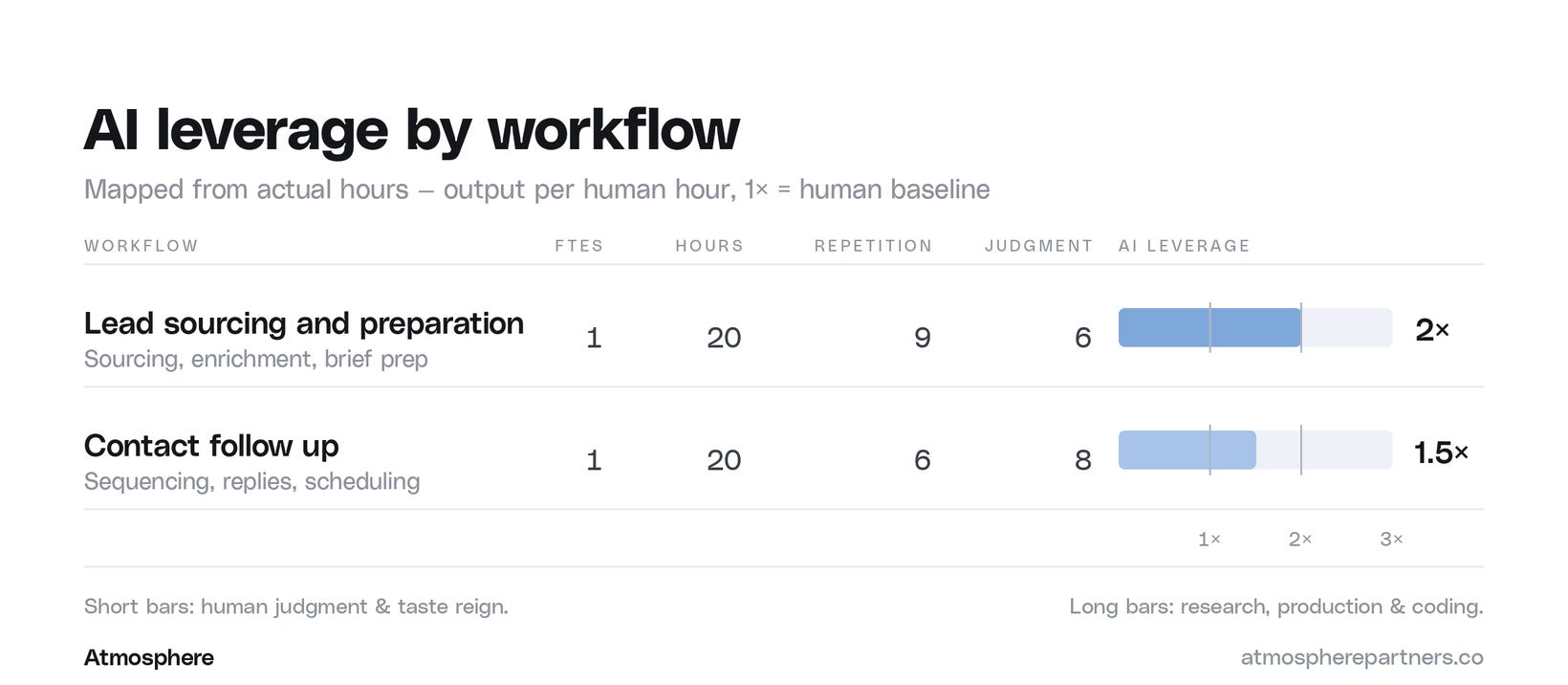
Your workflow scoring system needs to take several things into account at a minimum:
How many people touch it
Hours per week consumed
How repetitive the task is (score of 1 - 10)
How much human judgment is required (score of 1 - 10)
Where to apply AI
High-volume, high-repetition, low-judgment tasks pay back the fastest with AI. The graveyard for AI deployments is filled with projects that require human judgment and taste.
As a practical example, we worked with a company that needed to process ~200 leads per month to get 40% qualified with a close rate of 20%. That volume is ~2 SDRs going full tilt or ~$40k per quarter. It’s why SDR automation is such a hot topic.
TAM building and data enrichment is widely available and CRM systems have automated sequences (email etc.). That part is straightforward. We’ll cover the tools next time.
The problem was the upper funnel increase created a downstream mess in alerts, CRM data quality, human sales follow up and billing and revenue visibility. The solution was to step back and build AI enhancement into the other areas to calm the feral otter.
The lesson: own the system for your AI implementation
The end output is a structured quantification of your workflows (how many people, how repetitive a task, time spent on average etc.). The map is a spreadsheet and set of workflow diagrams. Every task in a row quantified with an assessment of AI lift. The top rows become your AI implementation plan for the quarter. The full list is your annual roadmap.
To give another practical examples for high-touch, BD type relationships. Lead sourcing gets high leverage, whereas follow up is quite specific and has a much higher judgment score. Repetition and judgment are coded scores, 1-10.
Change Management
Once you have your map, you need to spend several cycles deciding on the areas where AI can have maximum efficiency and ROI for your organization. But a plan that no one adopts is slideware. Which brings us to why most AI deployments are failing.
You need to socialize with your team. Your team members need to be bought in and frankly should be excited about removing tedious and repetitive work.
How to do this? Bring people in early. Make them part of the discovery process. Be transparent about where the judgment lines sit and where you believe that humans add the most value. You’ll be surprised during the discovery process about how nuanced work is and how hard it actually is to get a machine to repeatedly produce the right answer. It’s why you hired good people in the first place!
Build in review cycles where you sit together, review the roadmap, discuss tradeoffs, and most importantly, listen to concerns.
Fear will nuke your deployment. If the message gets delivered as ‘your job is going away’ adoption will be zero. AI without a human operator is essentially useless.
Next post: Which AI tools and platforms to actually use (or build your own)